Denmark for nomads
Updated:
 Sarah KuhlemannCommunity manager
Denmark is one of the easiest places in Europe to live and work remotely. Cities are built around bikes, trains run on time, fiber is standard, and almost everyone you meet speaks fluent English. Copenhagen gets the headlines, but Aarhus and Odense give you the same Danish quality of life at a calmer pace.
The catch is cost and paperwork. Denmark is one of the most expensive bases in Europe, furnished short-term housing is scarce, especially in Copenhagen, and there is no digital nomad visa. This guide covers what a month really costs, how long you can legally stay, and where to base yourself.
🌱 Health insurance for Denmark
Genki TravelerA travel health insurance with worldwide cover. Monthly payment plans, and easy signup in less than 1 minute.Discover Genki Traveler🎯 Denmark at a glance
| 🛂 Visa | EU and EEA: free movement. Non-EU: 90 days in any 180 (Schengen). No digital nomad visa |
| ⏳ Max stay | 90 days in 180 visa-free. EU citizens register after 3 months |
| 💶 Monthly budget | €1,400 in Odense to €3,700 in central Copenhagen for a short stay (November 2026) |
| 🌤 Best time | May to September for long days. December for Christmas markets and hygge |
| 🏝 Top areas | Nørrebro, Vesterbro, Frederiksberg (Copenhagen), Latin Quarter (Aarhus), central Odense |
| 🛜 Internet | Fiber in every city, nationwide 4G and 5G, EU roaming rules apply |
| 🛡 Safety | US advisory Level 2 (increased caution) for terrorism, issued September 2024. Everyday crime is low |
🇩🇰 Entry requirements for Denmark
- EU and EEA citizens: free movement with a national ID card or passport. For stays longer than 3 months (6 months if you are looking for work), you need an EU residence document from SIRI, Denmark's Agency for International Recruitment and Integration. If you support yourself, you have to show you can cover your first 12 months. Nordic citizens can live and work in Denmark without any permit.
- Non-EU citizens: Denmark is in Schengen. Visa-free nationalities get 90 days in any 180-day period, counted across all Schengen countries. Everyone else needs a Schengen visa before traveling.
- EES: the EU's Entry/Exit System registers non-EU short-stay travelers with fingerprints and a facial image at the border. Overstays are now flagged automatically.
- ETIAS: not in operation yet. As of November 2026, the European Commission says it will announce the start date several months in advance. The fee is set to be €20 once it launches.
There is no digital nomad visa
Denmark's official immigration portal, nyidanmark.dk, lists no digital nomad or remote-work permit. The general rule on the portal is that foreign nationals who work in Denmark need a residence and work permit. The exemptions are narrow, such as short business trips for a foreign company or invited researchers. Remote work for a foreign employer or your own clients during a tourist stay is not addressed. Treat it as a gray area, keep visits short and tourist-like, and ask SIRI if your situation is unusual. Staying longer than 90 days as a non-EU citizen means a work, study or family permit, not a nomad route.
Tax: the 6-month rule
Denmark does not use a simple 183-day count. According to the Danish Tax Agency, you become fully tax liable if you live in Denmark, or if you stay for 6 consecutive months. Short trips abroad, such as holidays, do not break that period. Once the 6 months are reached, liability applies from the first day of your stay. This is general information, not tax advice. The guide to tax residency and the 183-day rule explains why day counts are only part of the picture.
✈️ How to get to Denmark
- Copenhagen (CPH): the main gateway, on Amager. The M2 metro line and regional trains reach the city center in about 15 minutes.
- Billund (BLL): the hub for Jutland, with low-cost routes across Europe. There is no rail link, so buses connect it to Vejle and Aarhus.
- Aarhus (AAR): a small airport northeast of the city, with an airport bus into town.
By train: direct trains from Hamburg reach Copenhagen in about 5 hours, via Odense. The Øresund train links Malmö in Sweden with Copenhagen in about 40 minutes, stopping at the airport. Book on DSB.
🗺 Where to base yourself
- Copenhagen has the biggest international scene and the highest prices. Nørrebro is multicultural, packed with cafés and the best value close to the center. Vesterbro puts you next to the Kødbyen food district, two of the coworking spaces below and Central Station. Frederiksberg is green and quiet, with parks and the lakes nearby. Christianshavn is canals, houseboats and harbour baths, a few minutes by metro from the center. Amager, around Islands Brygge and Amagerbro, gives you harbour swimming, more space for the money and the metro to the airport.
- Aarhus, Denmark's second city, is younger and cheaper, with a big student population. The Latin Quarter is its oldest and most café-dense area. Aarhus Ø is the new waterfront district, with the harbour bath and Dokk1 library on the doorstep.
- Odense sits halfway between Copenhagen and Aarhus on the main rail line. It is compact, walkable and noticeably cheaper. Base yourself in the city center near the station. There is no real nomad scene, but there is little friction either.
- Aalborg is the budget pick. It is a university city on the Limfjord where an average two-room rental costs less than half of Copenhagen's (BoligPortal, July 2026). Choose it for low costs and quiet focus, not community.
💶 How much does it cost?
| Per month | Furnished studio or 1BR | Coworking | Food | Transport | Realistic total |
|---|---|---|---|---|---|
| Copenhagen (Nørrebro, Vesterbro, Frederiksberg) | €1,800–2,500 | €0–320 | €450–650 | €72 (pass) | €2,500–3,700 |
| Aarhus (Latin Quarter, Aarhus Ø) | €1,100–1,600 | €0–590 | €400–550 | €30–60 | €1,700–3,000 |
| Odense (center) | €900–1,300 | €0–250 | €380–520 | €30–50 | €1,400–2,300 |
| Aalborg (center) | €800–1,200 | €0–200 | €350–500 | €30–50 | €1,300–2,100 |
These are realistic short-stay figures for a furnished place booked for one to three months, dated November 2026 at €1 = 7.46 DKK. The krone is pegged to the euro at a central rate of 746.038 DKK per 100 euro, so conversions barely move. The totals add €100 to €200 for phone, gym and everything else, and the €0 coworking floor assumes you work from libraries. For comparison, the average unfurnished one-room flat in Copenhagen was 9,900 DKK (about €1,330) in July 2026 according to BoligPortal. Furnished monthly stays sit well above that.
Why short-term housing is hard. Copenhagen residents may rent out their whole home for at most 70 days a year through a platform, and the city enforces this. Many of the summer flats you see are people's real homes, available for a few weeks at most. Expect a deposit of one to three months' rent on private sublets, never pay before seeing a contract, and check that the landlord is real.
Coliving is the practical workaround. LifeX runs furnished shared apartments in Copenhagen, including a new site in Nordhavn's Nordhus cultural building, and in Aarhus. Rooms start at DKK 6,200 (about €830) and studios at DKK 12,000 (about €1,610) a month. The minimum stay is 3 to 6 months, and you pay a deposit of about one month plus the last month in advance. For shorter stays, Zoku Copenhagen offers serviced lofts with kitchens and lower rates from 5 nights.
Getting around in Copenhagen: a 2-zone monthly pass covering the center costs 540 DKK (about €72) from January 2027. Most people cycle anyway.
 Europe under €1,500 a month: 10 cities checkedEurope on a budget still exists, just not where it used to. We checked 16 cities against €1,500 a month with 2026 data: here are the 10 that work, from Bansko to Palermo, with the conditions spelled out.
🧑🏻💻 Where to work from
Copenhagen
- Republikken: one of the city's coworking pioneers, open since 2005, on Vesterbrogade, 7 minutes from Central Station. A hot desk costs 1,300 DKK + VAT a month, and a day pass costs 250 DKK for 8 hours. It runs a weekly community breakfast, and members get free access to betahaus spaces across Europe.
- SOHO Kødbyen: a large coworking community in the former Meatpacking District, with Friday bars and a daily canteen lunch. An on-the-fly desk costs 1,900 DKK + VAT a month.
- Zoku Copenhagen: rooftop coworking near DR Byen metro. A day pass costs 115 DKK, or 245 DKK with lunch, and unlimited membership costs 1,500 DKK a month. There is a daily social coffee break at 15:30, and on the first Monday of each month a day pass with lunch costs 149 DKK.
- La Oficina: club-style coworking in a historic Frederiksberg building near Forum metro. Prices are on request, and you can book a free trial day.
- Libraries: the Royal Danish Library's Black Diamond on the harbour is free, and its study reading rooms are open to everyone (8:00 to 20:00 on weekdays, 9:00 to 18:00 on Saturdays, 10:00 to 16:00 on Sundays). The Main Library on Krystalgade is a central alternative.
Aarhus
- LYNfabrikken: a coworking space for about 40 freelancers in an old factory in a Latin Quarter backyard. A desk costs 3,500 DKK + VAT a month, with 24-hour access. The rooftop coffee bar is open daily from 8:00 to 22:00 and works for café sessions.
- Dokk1: the harbourfront library and culture house. It is free and open 8:00 to 22:00 on weekdays and 10:00 to 16:00 at weekends.
Odense
- Main Library in Borgernes Hus: next to the station, with free seating and wifi. International House Odense is in the same building.
- Chains: Regus and Spaces run day passes and flexible desks across Denmark. In Copenhagen, a Spaces day pass starts at 250 DKK.
👥 Finding community
- Copenhagen Remote Workers, Freelancers and Digital Nomads on Meetup runs in-person events, and it has a companion Facebook group, Copenhagen Freelancers and Digital Nomads.
- Coworking rituals: Republikken's weekly breakfast, Zoku's daily 15:30 coffee break and SOHO's Friday bars are the easiest ways in.
- LifeX members get community events and an app to connect with housemates across cities.
- International House in Copenhagen and Odense helps newcomers with registration and runs welcome events.
 Coliving in Europe: the best spaces for digital nomadsEurope's best coliving spaces by region and season, from an Alpine citadel to small surf towns, with prices checked November 2026 and the Schengen 90/180 maths.
 Digital nomad events in Europe 2026/27Europe runs the biggest nomad festival on earth (Bansko) and a dense spring-to-autumn calendar of summits, island retreats and community weeks around it. The season is long, roughly April to December, and spread from the Bulgarian mountains to the Canary Islands, so the planning question is less "is there an event" and more "which three can I string together without crossing the continent twice."
🛜 Internet and SIM cards
Denmark's connectivity is among Europe's best. Fiber is standard in cities, and 4G and 5G cover the country. The networks are run by TDC, Telia, Telenor and 3, and prepaid SIMs are sold in supermarkets and kiosks. EU roaming rules apply, so an existing EU SIM works without extra charges.
The simplest option is a global eSIM from Pangia: one plan that covers Denmark and whatever country comes next, set up before you land.
🌤 When to go where
| J | F | M | A | M | J | J | A | S | O | N | D | |
|---|---|---|---|---|---|---|---|---|---|---|---|---|
| Copenhagen | 🌧 | 🌧 | 🌧 | ⛅ | ☀️ | ☀️ | ☀️ | ☀️ | ☀️ | ⛅ | 🌧 | ⛅ |
| Aarhus and Odense | 🌧 | 🌧 | 🌧 | ⛅ | ☀️ | ☀️ | ☀️ | ☀️ | ☀️ | ⛅ | 🌧 | ⛅ |
| Skagen and Bornholm | 🌧 | 🌧 | 🌧 | 🌧 | ⛅ | ☀️ | ☀️ | ☀️ | ⛅ | 🌧 | 🌧 | 🌧 |
☀️ best · ⛅ mixed · 🌧 dark or wet
Light matters more than temperature here. Summer brings very long evenings, harbour swimming and festivals. From November to February, daylight shrinks to a few hours, and many people find that harder than the cold. December is marked as mixed because the darkness comes with Christmas markets, Tivoli's winter season and peak hygge. The guide to Europe's best Christmas markets covers the season.
🚌 Getting around
- Cycling: the default way to get around. Use bike lanes, signal with your hand before stopping or turning, use lights after dark, and always lock your bike. Bike theft is common.
- Tickets: the physical Rejsekort card closed on June 30, 2026. Use the Rejsekort app to check in and out (it can check you out automatically), or the Rejsebillet app to buy single tickets and passes with a payment card. Both cover buses, trains, metro and light rail nationwide, but the Rejsekort app does not work on Bornholm's buses.
- Copenhagen metro and S-trains: the metro runs around the clock. S-trains cover the suburbs.
- DSB intercity trains: Copenhagen to Odense takes about 1.5 hours and Copenhagen to Aarhus about 3 hours. Book on DSB.
- Ferries: they connect the islands. Bornholm is reached by fast ferry from Køge, or via Ystad in Sweden.
🚧 Safety
Denmark is one of the safest countries in Europe for everyday life. The US travel advisory rates it Level 2 (exercise increased caution) because of terrorism, issued September 17, 2024. Canada's advice notes that the Danish security service rates the threat at 4 of 5 (October 2026).
- Bike theft: the most likely crime you will face. Use two locks and do not leave a good bike outside overnight.
- Christiania: the self-governing "free town" in Christianshavn is free to visit in daylight. Residents and police closed the Pusher Street cannabis market in April 2024, but cannabis is illegal everywhere in Denmark, Christiania included. Ask before photographing people.
- Emergencies: dial 112.
🏥 Healthcare
EU and EEA visitors with an EHIC card get necessary treatment free at public hospitals and GPs. Residents who register for a CPR number get the yellow health card (sundhedskort) with free GP and hospital care.
Everyone else should know a rule many guides get wrong. According to the Danish Health Authority, people staying in Denmark temporarily are generally charged for acute and continued hospital treatment, unless they have documentation of a right to free care. In the Copenhagen region, call 1813 before going to an emergency department, unless the situation is life-threatening. Tap water is safe to drink everywhere.
🎖 Must see
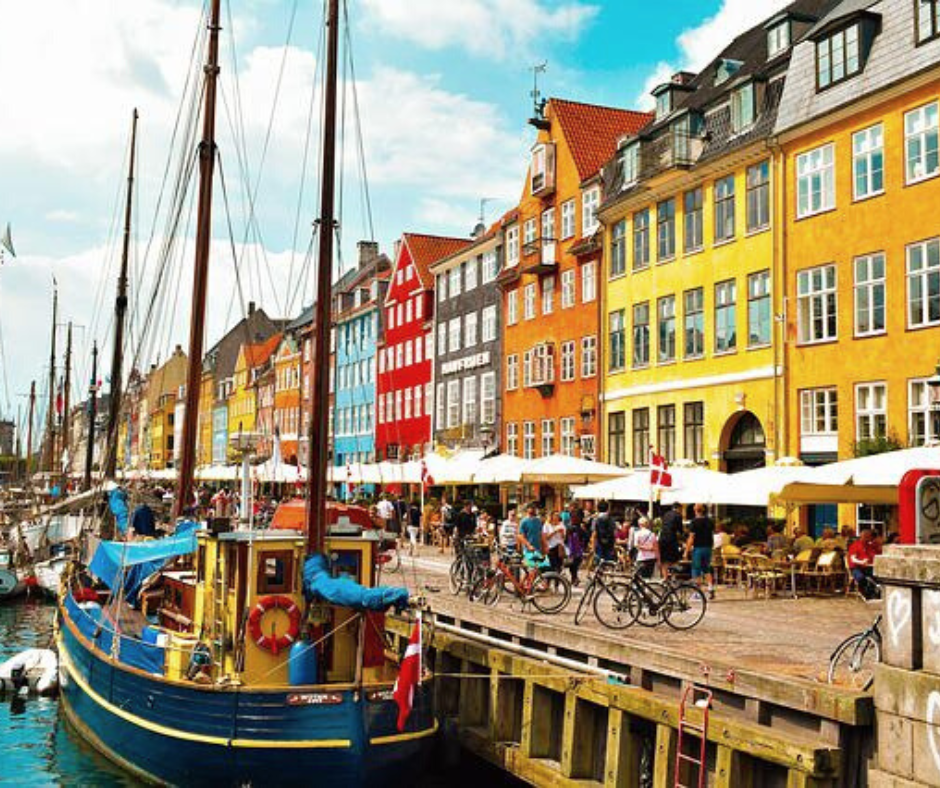
- Copenhagen: Nyhavn's harbour front, the harbour baths in summer, Tivoli and the Designmuseum.
- Louisiana Museum of Modern Art: modern art and a sculpture park on the coast in Humlebæk, north of Copenhagen by train.
- Kronborg: the UNESCO-listed Renaissance castle in Helsingør, known as Hamlet's Elsinore.
- ARoS in Aarhus: an art museum crowned by Olafur Eliasson's Your Rainbow Panorama.
- Skagen: Denmark's northern tip at Grenen, where two seas meet, and the light that drew the Skagen painters.
- Møns Klint: white chalk cliffs above the Baltic.
- Bornholm: a Baltic island of cliffs, round churches and the Hammershus ruin.
❓ Frequently asked questions
No. The official immigration portal lists no nomad or remote-work permit. Non-EU visitors get 90 days in any 180 under Schengen, and EU citizens can stay longer by registering for an EU residence document after 3 months.
About €2,500 to €3,700 for a short stay in a furnished studio, including coworking, food and transport (November 2026). Coliving or library working brings it lower, but rent is the line that decides your budget.
It is hard. Residents can rent out their whole home for at most 70 days a year, so supply is thin, especially in summer. Coliving operators like LifeX (3 to 6 month minimum) and serviced lofts at Zoku are the most reliable options. Expect deposits on private sublets.
The official rules do not address it. As a general rule, working in Denmark requires a permit, with narrow exemptions. Remote work for a foreign employer during a short visit is a gray area. Ask SIRI if you are unsure.
You become fully tax liable if you live in Denmark or stay for 6 consecutive months, and short trips abroad do not reset the clock. This is general information, not tax advice.
Copenhagen for community, coworking choice and connections. Aarhus for lower costs, a younger crowd and a calmer pace, with furnished stays roughly a third cheaper.
Traveling that area? Check out Denmark's neighborhood.
 Sweden for nomadsSweden is safe, English-speaking and fully digital, but it is expensive, dark in winter and has no nomad visa. Real 2026 costs for Stockholm, Gothenburg and Malmö, plus the new 160-day tax rule.
 Germany for nomadsGermany has no digital nomad visa, strict address registration and expensive short-stay flats. Here is how nomads live in Berlin, Hamburg, Munich, Köln and Leipzig in 2026, with real costs and verified coworking spaces.
 The Netherlands for nomads
 Iceland for nomads