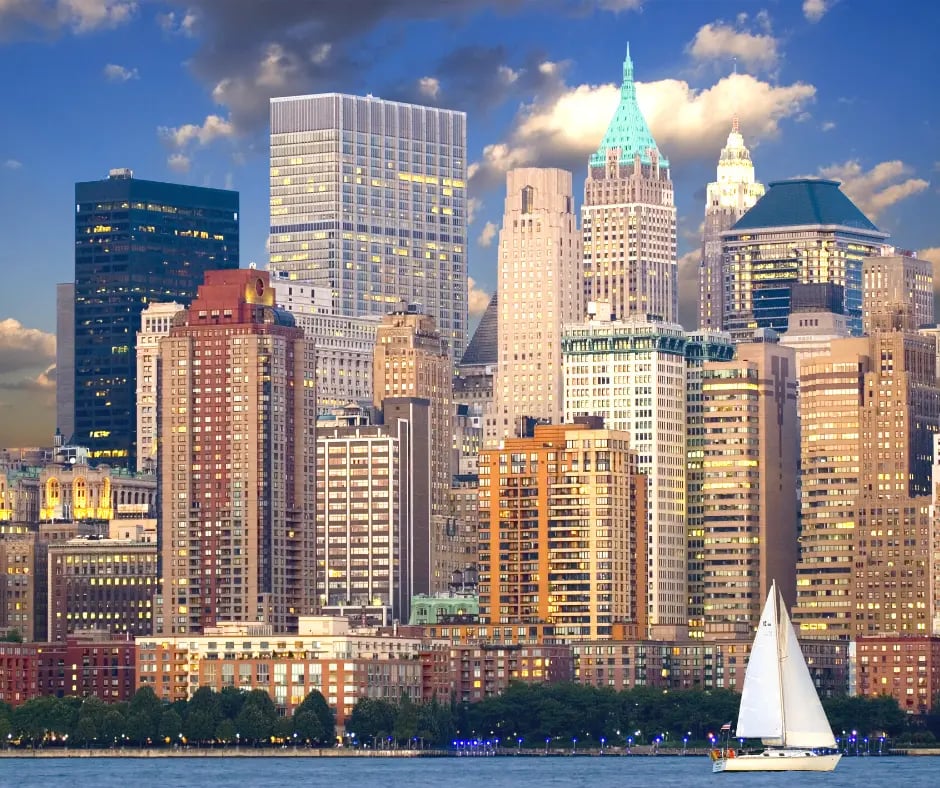
Chile and Santiago for digital nomads
Updated:
 Sarah KuhlemannCommunity manager
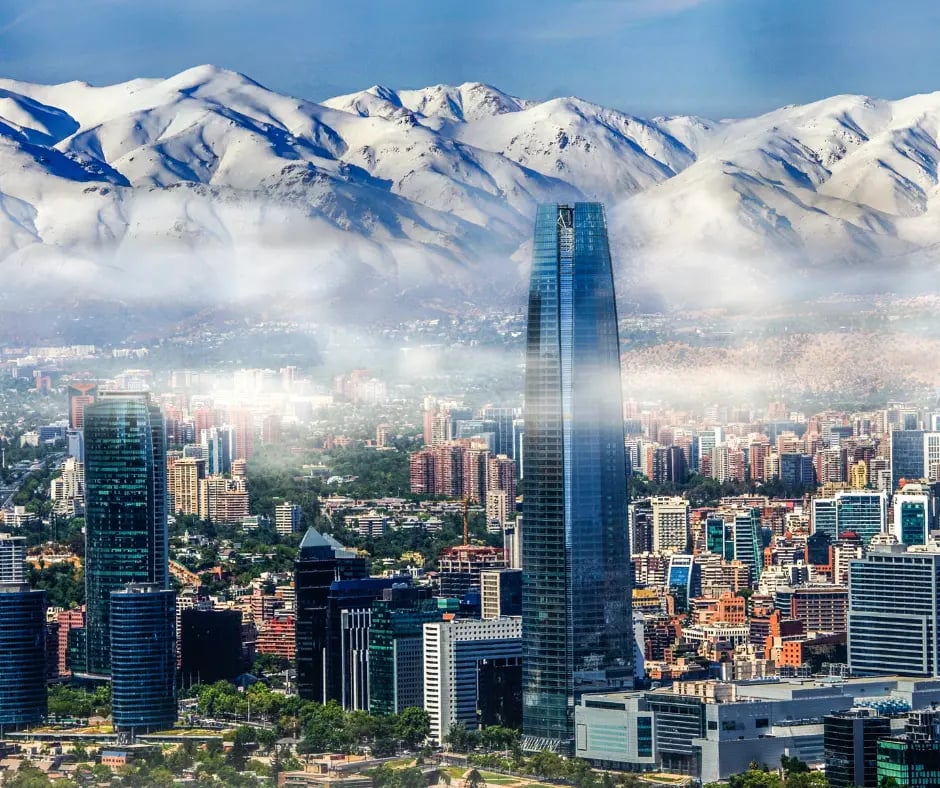
Chile is the most stable and developed country in South America, and one of its most underrated nomad bases. It has some of the fastest home internet on the planet, a capital with the Andes standing right behind the skyline, world-class wine an hour away, and a geography that runs from the driest desert on earth to the glaciers of Patagonia. Because the seasons are reversed, it is also summer here while Europe is in winter.
For most nomads, Chile means Santiago: the best infrastructure, the biggest community and the most coworking spaces in the country. Valparaíso and the Lake District are the alternatives for character or scenery. The visa answer comes first, because so many sites get it wrong: Chile has no digital nomad visa. Most nomads stay on the 90-day visa-free entry plus one 90-day extension. This guide covers both the country and the capital, with costs and spaces checked in November 2026.
🌱 Health insurance for Chile
Genki TravelerA travel health insurance with worldwide cover. Monthly payment plans, and easy signup in less than 1 minute.Discover Genki TravelerChile's private hospitals in Santiago, such as Clínica Alemana and Clínica Las Condes, are among the best in Latin America, and they expect visitors to pay or show insurance. The public insurer Fonasa and the private Isapres are built around people living and contributing in Chile: affiliation depends on income and migration status, such as a residence permit or one in process. On a tourist entry, plan on paying private clinics directly or through your own insurance.
🎯 Chile at a glance
| 🛂 Visa | No digital nomad visa. 90 days visa-free for most Western passports, extendable once by 90 days for US$100 |
| ⏳ Max stay | About 180 days per entry on the tourist route |
| 💶 Monthly budget | About €1,000 to €1,350 in Valparaíso, €1,050 to €1,750 in Santiago depending on the neighborhood |
| 🌤 Best time | October to November and March to April for Santiago and the coast, December to February for the Lake District and Patagonia |
| 🏙 Top areas | Providencia, Barrio Italia, Ñuñoa and Las Condes in Santiago, Cerro Alegre in Valparaíso, Puerto Varas |
| 🛜 Internet | In Ookla's global top five for fixed broadband in 2026, fiber is standard in cities |
| 🛡 Safety | US advisory Level 2 (exercise increased caution) for crime and unrest |
🇨🇱 Entry requirements for Chile
- Visa-free entry: Citizens of the EU, UK, US, Canada, New Zealand and many other countries get a tourist permit (Permanencia Transitoria) on arrival for up to 90 days. Australians have been visa-free since September 2025. Nationalities that need a visa apply at a Chilean consulate before travel.
- Extension: You can extend once by up to 90 days for US$100 (about €91), on the Servicio Nacional de Migraciones (SERMIG) online portal. Start before your first 90 days run out, and expect to show the reason for the extension and proof of funds.
- Tourist card: Keep the tourist card you receive at immigration. You hand it back when you leave.
- Working on a tourist entry: SERMIG states that holders of Permanencia Transitoria may not carry out paid activities in Chile without a separate work authorization. Chile has published no specific rules for remote work for foreign employers or clients, so this sits in a grey zone. Working for Chilean companies or clients is clearly not allowed.
Does Chile have a digital nomad visa?
No. Despite what some sites selling application services claim, the official list of 14 Residencia Temporal subcategories published by SERMIG has no digital nomad or remote work category, as of November 2026. The long-stay options that do exist:
- Paid activities (actividades lícitas remuneradas): For people with a Chilean employer or a formal job offer from a Chilean person or company. It does not fit remote work for a foreign employer.
- Rentistas: For people with steady income from real estate or financial assets that covers at least their basic needs in Chile. Freelance or salary income does not count.
- Mercosur reciprocity: Citizens of Argentina, Bolivia, Brazil, Paraguay and Uruguay can get temporary residence on easier terms.
All of these are applied for from abroad on the SERMIG portal and run for up to two years.
 Countries with nomad visasWhich countries offer digital nomad visas, what do they cost, and which one fits your income and plans? Here are the programs worth knowing, with requirements, fees, and insurance rules verified against official sources.
✈️ How to get to Chile
- By air: The main gateway is Santiago's Arturo Merino Benítez International Airport (SCL), with direct flights from Europe, North America and across Latin America. The official Centropuerto bus runs every 15 minutes to Metro Pajaritos and Metro República from CLP 2,500 (about €2.30). Ride-hailing and the airport's official taxis cover door-to-door transfers.
- Overland from Argentina: Buses run from Mendoza to Santiago over the Andes via the Los Libertadores pass (Cristo Redentor on the Argentine side). In winter the pass runs shorter hours and can close for days or weeks after heavy snow, so check its status before booking.
- Overland from Peru: The usual route is Tacna to Arica in Chile's far north, then a domestic flight or a long bus ride south.
🗺 Where to base yourself
Santiago
Santiago is where most nomads land, and the neighborhood matters more than in most capitals. The east of the city is safer, greener and better connected for remote work than the center.
- Providencia: The nomad default. Walkable and leafy, full of cafés, coworking spaces and metro stations along Line 1. If it's your first time in Santiago, start around Pedro de Valdivia, Los Leones or Barrio Suecia.
- Barrio Italia: The southern edge of Providencia and the city's creative quarter, with design shops, courtyard cafés and iF Italia, the city's best-known coworking community.
- Lastarria: Small, historic and central, with cinemas, bookshops and the GAM cultural center. Lively and charming, but closer to the protest zone around Plaza Baquedano than the other bases.
- Ñuñoa: More local and residential, noticeably cheaper than Providencia, with a lively scene around Plaza Ñuñoa. The best value base if you want to live like a santiaguino.
- Las Condes (El Golf): The polished business district, with most of the corporate coworking, the highest rents and the quietest streets. Very comfortable, short on character.
- A word on Centro and Bellavista: Central, cheap and full of character and nightlife, but phone snatching is a real problem. Fine to visit, weaker as a base.
Valparaíso and Viña del Mar
Valparaíso is the painted UNESCO port city about 1.5 to 2 hours from Santiago by bus: cheaper, artsier and rougher around the edges. Cerro Alegre and Cerro Concepción are the classic bases, with cobbled lanes, bay views and good cafés. Viña del Mar next door is the tidy beach city, with less character, more infrastructure and most of the area's coworking.
Puerto Varas
A lake town on Lago Llanquihue facing the Osorno volcano, and the Lake District's strongest work base, with a small but real coworking scene. It is best from December to March. Summer is also peak season, when rents climb, so book early.
Pucón
Chile's adventure capital on Lago Villarrica, busy in January and February and quieter and cheaper the rest of the year. Come for the volcano, lakes and hot springs. Coworking options are thin, so plan to work from your accommodation.
Trip territory, not bases
The Atacama Desert and Patagonia are extraordinary to visit but poor places to work from. Connectivity is patchy outside towns and lodges, so plan light workdays (see Must see).
💶 How much does it cost?
| Per month | Santiago (Providencia) | Santiago (Ñuñoa) | Valparaíso (Cerro Alegre) | Lake District (Puerto Varas) |
|---|---|---|---|---|
| Furnished 1BR, monthly | €650–900 | €500–700 | €420–600 | €500–800 (higher in summer) |
| Coworking | €80–185 | €80–185 | €90–120 (day passes) | €80–120 |
| Food | €400–550 | €380–500 | €400–500 | €400–550 |
| Transport | €35–50 | €35–50 | €30–50 | €40–80 |
| Utilities and SIM | €60–90 | €60–90 | €60–90 | €60–90 |
| Realistic total | €1,250–1,750 | €1,050–1,500 | €1,000–1,350 | €1,100–1,650 |
Estimates for a solo nomad staying one month in a furnished one-bedroom found on monthly terms, eating a mix of markets, set lunches and restaurants, with a coworking membership. Converted at €1 = CLP 1,110 (Banco Central de Chile, November 2026). Chile is pricier than Peru or Bolivia, cheaper than Western Europe, and the infrastructure is a step up from most of the region. A set lunch (menú del día) is one of the best-value meals in the country.
 Latin America for less than €1,500Latin America is no longer uniformly cheap. Ten cities checked against a €1,500 monthly budget with fresh 2026 data: six still fit comfortably, two need conditions, and two former favorites outgrew it.
🧑🏻💻 Where to work from
Santiago
- Launch Cowork: Several locations in Providencia (Holley, Los Leones, Manuel Montt) and Las Condes, memberships bought fully online. Plans run from CLP 74,900 plus VAT (about €80) for 30 hours a month at one location to CLP 169,900 plus VAT (about €183) for unlimited hours at all locations. A free trial day is available for new clients.
- iF Italia: Coworking and private offices at Avenida Italia 850 in Barrio Italia, with an active entrepreneur community. Pricing on request.
- Co-Work Latam: Twelve locations in Santiago, including Barrio Suecia in Providencia and several in Las Condes and Vitacura, plus Medellín, Montevideo and Miami if Santiago is one stop on a longer route. Pricing on request.
- WeWork Apoquindo 5950: WeWork's one Chilean building, in Las Condes. Day passes from CLP 36,000 (about €33), monthly memberships from about CLP 207,000 (about €187).
- Pronto Cowork: A chain of business centers with hot desks, including El Golf in Las Condes. Pricing on request.
Valparaíso and Viña del Mar
- Paralelo Cowork: The reliable workspace in Valparaíso itself, on Eusebio Lillo near the bus terminal, with 24/7 access. A day pass costs CLP 12,000 (about €11) including VAT, an hour CLP 5,000. Team and monthly deals on request.
- Pronto Cowork Mall Marina: Hot desks in Viña del Mar's Mall Marina. Pricing on request.
- Cowork de Bienestar: Quiet private offices by the hour in Viña del Mar, from CLP 7,500 (about €7), with fiber internet and no membership needed.
- A note on cafés: Valparaíso's hillside cafés are lovely but not built for laptops, and some have no wifi at all. Treat them as breaks.
The Lake District
- Casona 879 (Puerto Varas): A 1920s house in the center shared by more than 30 projects, with fixed desks from CLP 76,000 plus VAT a month (about €82), meeting rooms and a specialty café downstairs.
- CAMM Cowork (Puerto Varas): Desks inside the Molino Machmar cultural center for 2.6 UF plus VAT a month (roughly €110 to €115). The minimum contract is three months, so it suits longer stays.
👥 Finding community
Chile's nomad scene is smaller and more local than Colombia's or Mexico's, and it skews professional rather than backpacker. Even basic Spanish opens a lot of doors.
- Coworking communities: iF Italia's events and workshops make it the coworking with the strongest community in Santiago, and Launch's multi-location memberships make it easy to meet people across neighborhoods.
- Language exchanges: Spanglish Party runs regular Spanish and English exchange nights in Santiago, one of the easiest first evenings in the city.
- InterNations: The Santiago chapter hosts monthly events plus hiking and professional groups.
- Facebook groups: Santiago Chile English Speaking Expats, Expats in Chile Network and Gringos in Chile are the active entry points. Current WhatsApp invites are usually pinned inside these groups.
- Puerto Varas: The community centers on Casona 879, with a café, a garden and regular get-togethers.
 Upcoming nomad events & festivals in 2026-2027Compare upcoming digital nomad events and festivals for 2026/27, with dates, prices, locations, and what to expect at each.
 Upcoming nomad retreats and pop-ups in 2026-2027From month-long colivings in Costa Rica to a 90-day pop-up in Ecuador: find nomad retreats and workations where you arrive solo and leave with a tribe.
 Latin America's best coworking spacesPlenty of coworking spaces claim to build community. Not all of them do. These nine places across Mexico, Argentina, Brazil, Colombia, Costa Rica, Ecuador and Puerto Rico are ranked by the one thing hardest to fake: whether people actually make friends there.
 The best coliving spaces in Latin America, checked for 2026Eleven coliving houses across Mexico, Colombia, Argentina, Brazil, Peru, Costa Rica and Puerto Rico, each checked on its own website in November 2026 for price, minimum stay and who it suits.
🛜 Internet and SIM cards
This is one of Chile's real advantages. The country sat in Ookla's global top five for fixed broadband through 2026, with median speeds above 350 Mbps, and Valparaíso was named the city with the fastest fixed internet in the world in Ookla's mid-2026 index. Fiber is standard in Santiago, Valparaíso and Viña del Mar, and the Lake District towns are well connected. Only the far desert and deep Patagonia are patchy, where many lodges now rely on Starlink.
The simplest way to stay connected is a global eSIM from Pangia: one plan that covers Chile and the next country on your route. For a longer stay, add a local prepaid SIM from Entel, Movistar or WOM, sold in their own stores against your passport. Entel has the best coverage if you plan to travel to the Atacama or Patagonia.
🌤 When to go where
| Region | 🌞 Best time | 🌧 Avoid | Why |
|---|---|---|---|
| Santiago | Oct-Nov, Mar-Apr | Jun-Jul | Warm, dry shoulder months. Summer days can pass 30°C, winter brings cold nights and smog episodes |
| Central coast | Oct-Apr | Jun-Aug | Mild and dry most of the year, winter is wet and grey |
| Lake District | Dec-Mar | May-Sep | Summer is the only reliably dry season, the rest of the year is rainy |
| Atacama | Year-round | None | Dry all year, desert nights are cold at altitude |
| Patagonia | Nov-Mar | Jun-Aug | Long summer days, winter closes many services |
Skiers should note the other season: the Andes resorts above Santiago open roughly from June to September.
🚌 Getting around
- Metro de Santiago: The backbone of the capital, with seven lines plus the Tren Nos commuter rail. Fares depend on the time of day: CLP 735 (about €0.66) early and late, CLP 815 (about €0.73) off-peak and CLP 895 (about €0.81) at peak, with off-peak fares all day on weekends. Buses are a flat CLP 795 (about €0.72), and a bus-metro combination costs at most a small top-up. You pay with a Bip! card, CLP 1,550 (about €1.40) at any station.
- Ride-hailing: Uber, DiDi and Cabify are the practical choice at night and for airport runs.
- Buses between cities: The main way to travel in Chile, comfortable and cheap, with seat classes up to fully reclining salón cama. Turbus and Pullman are the big operators.
- Trains: EFE runs a Santiago to Chillán service south through the Central Valley, plus regional lines, including Llanquihue to Puerto Montt in the Lake District.
- Domestic flights: LATAM, Sky Airline and JetSMART cover the long distances, such as Santiago to Puerto Montt for the Lake District, Calama for the Atacama or Punta Arenas for Patagonia.
🚧 Safety
The US State Department rates Chile Level 2, exercise increased caution, for crime and civil unrest (updated August 2026). Canada advises a high degree of caution for the same reasons (October 2026). In practice:
- Street crime: Phone snatching and pickpocketing are the most common problems in central Santiago, on public transport and in touristy parts of Valparaíso. The US advisory also notes that violent crime is rising. Keep your phone off café tables and hold bags on the metro.
- Demonstrations: Large protests happen periodically in Santiago, usually around Plaza Baquedano, often at short notice and with metro disruptions. Avoid them.
- Valparaíso after dark: Some hillside areas are best avoided at night. Ask locally which cerros are fine and use ride-hailing.
- Southern regions: Parts of La Araucanía and Biobío have a history of politically motivated violence and a state of emergency. The tourist areas around Pucón are not where most incidents occur, but check the current advice before traveling there.
- Earthquakes: Chile is one of the most seismically active countries on earth, with strict building codes. Learn your building's exits and, during shaking, drop, cover and hold.
🏥 Healthcare
Private healthcare in Santiago is excellent by regional standards, with English-speaking doctors common at the big clinics such as Clínica Alemana and Clínica Las Condes. Outside the capital, the larger cities have private clinics, while remote areas may mean a transfer. Tap water is safe to drink in Santiago and most cities, though its high mineral content upsets some stomachs at first. In deep winter, Santiago's air quality can drop for days at a time. Emergency numbers: 131 ambulance, 132 fire, 133 police.
🎖 Must see
- Atacama Desert: Geysers, salt flats, flamingo lagoons and some of the clearest night skies on the planet, based in San Pedro de Atacama at about 2,400 meters.
- Torres del Paine: Patagonia's granite towers and one of the great treks anywhere. Book refugios and campsites well ahead for the summer season.
- Valparaíso: The mural-covered hills, funiculars and port, doable as a day trip from Santiago but better overnight.
- Wine valleys: Maipo on Santiago's doorstep, Casablanca on the way to the coast, and Colchagua around Santa Cruz for a weekend.
- Lake District: The Osorno volcano, the Petrohué falls and Lago Todos los Santos, all within easy reach of Puerto Varas.
- Cajón del Maipo: An Andean canyon an hour from Santiago with hiking, hot springs and the turquoise El Yeso reservoir.
❓ Frequently asked questions
No. SERMIG's official list of residence categories has no digital nomad or remote work category as of November 2026. Most nomads use the 90-day visa-free entry plus a 90-day extension, about 180 days per entry.
Yes, for nomads who value infrastructure and safety in the right neighborhoods over rock-bottom prices. Internet is among the fastest in the world, Providencia and Barrio Italia are walkable with plenty of coworking, and a realistic month costs about €1,250 to €1,750 there, or €1,050 to €1,500 in Ñuñoa.
Up to 90 days on arrival for most Western passports, extendable once by up to 90 days for US$100 on the SERMIG portal, so about 180 days per entry.
About €1,000 to €1,350 in Valparaíso, €1,050 to €1,750 in Santiago depending on the neighborhood, and €1,100 to €1,650 in Puerto Varas, higher in the summer peak.
Santiago for community, coworking and infrastructure. Valparaíso for character and value. Puerto Varas for lakes, volcanoes and a small coworking scene in summer.
October to November and March to April for Santiago and the coast. December to March for the Lake District and Patagonia. The Atacama works year-round.
Traveling that area? Check out Chile's neighborhood.
 Argentina for nomadsBuenos Aires is the most European city in the Americas: café culture, midnight dinners, grand boulevards and the best steak and wine anywhere. The catch in 2026 is that the legendary blue-dollar bargain is gone. Here is the honest guide.
 Peru for nomadsPeru's digital nomad visa exists only on paper, so nomads stay as tourists. How long you can stay, what Lima, Arequipa and Cusco really cost, and where to work in 2026.
 Latin America made easyWhere to start in Latin America as a remote worker: 11 bases compared on real monthly costs, the visa that works in each, internet, seasons, and two sample routes for your first three months.