USA west coast for nomads
Updated:
 Sarah KuhlemannCommunity manager
The US West Coast packs a lot into one road trip: the tech scene of San Francisco and Seattle, the beach towns of Southern California, Portland's coffee and bike culture, and some of the world's best-known national parks a few hours inland. The internet is fast, coworking spaces are everywhere, and English makes daily life easy for most nomads.
It is also one of the most expensive regions nomads go to. Short-term rent, healthcare and cars all cost more than almost anywhere else, and the US has no digital nomad visa. This guide covers what that means for entry, where to base yourself, what a month really costs in 2026, and why health insurance needs a closer look here than anywhere else.
🌱 Health insurance for the US West Coast
Genki TravelerA travel health insurance with worldwide cover. Monthly payment plans, and easy signup in less than 1 minute.Discover Genki TravelerThe US is a special case for health insurance, so check how your plan treats it before you fly:
- Genki Traveler: with the region "worldwide", you are covered in all countries, including the US. With "worldwide (limited in Canada & USA)", you are covered in the US only for medical emergencies that started within 7 days of arriving there. In the US, you pay the first €100 per visit to an emergency room or urgent care center yourself. This is separate from the deductible and does not apply if the visit leads to a hospital stay (Genki Traveler insurance conditions).
- Genki Native: in the US, care is covered only for a medical emergency, including follow-up care and repatriation. The emergency must start within 91 days of your arrival, after at least 91 consecutive days outside the US. The US limit per insurance year is €250,000 with Basic and €500,000 with Premium, and a 3-month waiting period applies (Genki Native table of benefits). If you need more than emergency coverage in the US, Genki suggests adding Genki Traveler alongside Genki Native for the temporary stay. These are the current conditions (version "1 September 2026"). If your Genki Native insurance started earlier, your previous conditions apply until your next insurance year: check which version applies to you under Insurance Conditions in the Member Center.
🎯 USA West Coast at a glance
| 🛂 Visa | ESTA (about €37) for Visa Waiver Program countries, otherwise a B-1/B-2 visitor visa |
| 🪪 Nomad visa | None. Visitor stays do not allow employment |
| ⏳ Max stay | 90 days on ESTA, no extension. Usually up to 6 months on a B-2 visa |
| 💶 Monthly budget | About €3,000 in Portland to €6,300 in San Francisco for a one-month stay |
| 🌤 Best time | September and October nearly everywhere. Summer in Seattle and Portland |
| 🧑🏻💻 Top bases | San Francisco, Los Angeles, San Diego and Encinitas, Portland, Seattle |
| 🛜 Internet | Fast: median fixed broadband above 300 Mbps nationwide |
| 🔥 Natural hazards | Wildfires and smoke, earthquakes, rip currents |
| 💱 Currency | US dollar (USD). €1 is around $1.11 (November 2026) |
🇺🇸 Entry requirements for the USA
- ESTA and the Visa Waiver Program: citizens of Visa Waiver Program countries, including most EU countries, the UK, Australia, New Zealand, Japan and South Korea, can visit for tourism or business for up to 90 days without a visa (US State Department). You need an approved ESTA before you fly. Since October 16, 2026 the ESTA fee is $40.62 (about €37), after an inflation adjustment published in the Federal Register on October 1, 2026. An ESTA is valid for two years, or until your passport expires if that comes sooner. Apply only at esta.cbp.dhs.gov or through CBP's official app. The 90 days cannot be extended, and short trips to Canada, Mexico or the Caribbean do not reset them.
- Visitor visa (B-1/B-2): travelers who are not eligible for the Visa Waiver Program apply for a visitor visa at a US embassy. The application fee is $185. A $250 visa integrity fee is set by law, but collection has been uneven, so check your embassy's fee page before you apply. B-2 visitors are usually admitted for up to 6 months, decided by the officer at entry.
- No digital nomad visa: the US has no visa for remote workers. The guide to countries with nomad visas lists the alternatives.
- Remote work: the State Department says a person on a visitor visa is not permitted to accept employment or work in the US, and lists employment among the activities that require a different visa. Visa Waiver travelers are under the same limits. No official rule says that remote work for a foreign employer is allowed, and immigration lawyers widely read the rules as not permitting it. Plan any US stay as a visit, not a work base.
✈️ How to get to the West Coast
- Los Angeles (LAX): the largest gateway, with direct flights from Europe, Asia, Australia and Latin America. Burbank (BUR) and Long Beach (LGB) handle many domestic flights.
- San Francisco (SFO): the Bay Area's international hub, with BART trains into the city. Oakland (OAK) and San Jose (SJC) are alternatives.
- San Diego (SAN): close to downtown, with mostly domestic and some international routes.
- Seattle (SEA): direct flights to Europe and Asia, and Link light rail into downtown.
- Portland (PDX): mostly domestic flights, with MAX light rail into the city.
🗺 Where to base yourself
San Francisco is compact, hilly and the most expensive base on the coast. The Mission is sunny by local standards, with cafés, taquerías and nightlife. Hayes Valley is central and walkable, with boutiques and good transit. Fog-prone neighborhoods further west are quieter and a little cheaper. The Bay Area's tech scene means events every week, and Golden Gate Park and the coast are close.
Los Angeles is a collection of cities, so pick one area and stay put. Santa Monica and Venice on the coast have the beach, the bike path and the most coworking options. Silver Lake and Echo Park on the east side are creative, café-heavy and slightly cheaper. Traffic decides your daily life, so live close to where you work.
San Diego has the mildest weather in the country and a relaxed beach culture. North Park and Hillcrest are walkable, with breweries and cafés. Little Italy is the polished downtown option. Thirty minutes north, the North County coast around Encinitas, Leucadia and Carlsbad is a string of surf towns along Highway 101, with a calmer pace and a growing remote-work crowd. The Coaster commuter train links it with downtown San Diego.
Portland is the most affordable big city on this list, with a strong coffee, food-cart and cycling culture. The Pearl District is central and walkable. The Alberta Arts District on the east side is creative and residential. Expect grey, wet winters.
Seattle combines a big tech scene with water and mountains on every side. Capitol Hill is lively and dense with cafés and bars. Fremont and Ballard to the north are quieter, with a neighborhood feel and easy access to the water.
💶 How much does it cost?
| Per month | San Francisco | Los Angeles | San Diego | Portland | Seattle |
|---|---|---|---|---|---|
| Furnished studio (1 month) | €3,000–4,500 | €2,700–4,000 | €2,500–3,800 | €2,000–2,900 | €2,500–3,600 |
| Room in a shared flat | €1,400–2,200 | €1,300–2,000 | €1,200–1,900 | €1,000–1,500 | €1,200–1,800 |
| Coworking | €300–600 | €110–450 | €180–450 | €250–450 | €250–500 |
| Food | €700–1,000 | €650–950 | €600–900 | €550–800 | €650–950 |
| Transport | €80–100 | €65 transit, €1,000+ with a car | €80–100, more with a car | €70–90 | €80–100 |
| SIM and data | €30–60 | €30–60 | €30–60 | €30–60 | €30–60 |
| Realistic total | €4,200–6,300 | €3,600–6,400 | €3,400–5,300 | €2,900–4,300 | €3,500–5,200 |
These are estimates for a single nomad staying one month in a furnished studio, eating out regularly, before health insurance. A room in a shared flat lowers the totals by roughly €1,300 to €2,300 a month. Conversions use the European Central Bank reference rate of $1.1127 per euro on November 11, 2026.
Book a month or more where you can. In San Francisco, rentals of less than 30 nights count as short-term rentals that need a city registration, and guests pay a 14% hotel tax on them (San Francisco Planning). In Los Angeles, stays of more than 30 consecutive days count as long-term rentals and fall outside the city's home-sharing rules (Los Angeles City Planning). Monthly listings are therefore common, and often cheaper per night. Everyday costs add up too: tipping 18 to 20 percent is expected in restaurants, and sales tax is added at the till rather than included in the price.
🧑🏻💻 Where to work from
San Francisco
- Mindspace Market Street: coworking and private offices on three floors at 575 Market Street, close to Moscone Center and transit.
- CENTRL Office: a West Coast operator with a North Waterfront location in San Francisco, plus spaces in Los Angeles, Portland and Seattle, offering day passes, coworking and offices.
Los Angeles
- BLANKSPACES: a Los Angeles coworking network with locations in Santa Monica, Venice, Culver City, Hollywood, West Adams and Long Beach. Memberships start at $125 a month (about €112) for occasional use (November 2026).
San Diego and Encinitas
- Downtown Works: coworking in Little Italy, Pacific Beach, Mission Valley and Carlsbad. A day pass costs $40 (about €36), with day-pass bundles from $30 a day (November 2026).
- Cowork + Connect: a Hillcrest coworking space near North Park, with day passes from $25 (about €22) and part-time membership from $199 a month (about €179) (November 2026).
- Encinitas Coworking Co.: coworking and private offices on Coast Highway 101 in Encinitas, open Monday to Friday.
Portland
- CENTRL Office: locations in the Pearl District, the West End and on the Eastside, with day passes and coworking memberships.
Seattle
- The Cloud Room: a creative coworking space in Capitol Hill, with walk-in day passes, events and a bar.
- The Pioneer Collective: coworking in Belltown near Pike Place Market, plus locations in Ballard and West Canal Yards, with 1 Gbps fiber internet.
Café work is normal across the coast, and public libraries are a free, quiet alternative with good wifi.
 Asia's best coworking spacesPlenty of coworking spaces claim to build community. Not all of them do. These places across Thailand, Vietnam, Bali, Sri Lanka, Cambodia and the Philippines where strangers actually become friends, all verified open in 2026.
👥 Finding community
The West Coast has no single nomad hub like Lisbon or Chiang Mai, and most long-stayers find their people through coworking spaces, tech and startup events, and interest groups. Coworking spaces like The Cloud Room, BLANKSPACES and Downtown Works run member events, and Meetup and Luma list tech talks, run clubs, hiking groups and language exchanges in every city. In San Diego's North County, the surf, yoga and outdoor scene does the job: the guide to surfing as a nomad covers how to get into it.
 Upcoming nomad events & festivals in 2026-2027Compare upcoming digital nomad events and festivals for 2026/27, with dates, prices, locations, and what to expect at each.
🛜 Internet and SIM cards
Internet is fast and reliable in all five cities. Ookla's report for the first half of 2026 found median fixed broadband downloads above 300 Mbps across US providers, with fiber common in cities (Ookla). Coworking spaces and most rentals have fast wifi, and free public wifi is common in libraries and cafés.
The three national networks are T-Mobile, AT&T and Verizon, plus prepaid brands that use their networks. Prepaid plans need no US address or credit history, and most phones bought abroad support US eSIMs. Coverage is excellent in cities but patchy in national parks and along remote stretches of coast like Big Sur, so download offline maps before road trips.
If you prefer to land connected, a global eSIM from Pangia covers the US and your next stops, such as Mexico, in one plan.
🌤 When to go where
| Base | 🌞 Best time | 🌧 Watch out for | Why |
|---|---|---|---|
| San Francisco | Sep–Oct | Jun–Aug fog, wildfire smoke in late summer and autumn | The city's warmest, clearest weather comes in early autumn. Summer is often cold and foggy |
| Los Angeles | Sep–Nov, Mar–May | May–June gloom, Santa Ana winds and fire risk in autumn and winter | Mild almost all year. Grey coastal mornings in early summer |
| San Diego and Encinitas | Sep–Nov | May–June gloom | The mildest climate in the US. Late summer and autumn bring the warmest sea |
| Portland | Jun–Sep | Oct–Apr rain, wildfire smoke in late summer | Dry, sunny summers. Long, grey, wet winters |
| Seattle | Jul–Sep | Oct–Apr rain, wildfire smoke in late summer | Some of the best summer weather in the country. Short, dark, drizzly winter days |
Wildfires are part of life in California, Oregon and Washington, and smoke can affect air quality hundreds of kilometers away. Check AirNow for air quality and CAL FIRE for active fires in California. Coastal Southern California's "May gray" and "June gloom" bring low clouds that often burn off by the afternoon.
🚌 Getting around
- The car reality: Los Angeles and much of San Diego County are built around cars, and national parks, Big Sur and most hikes need one. San Francisco, Portland and Seattle work well without a car. Rental cars are expensive for a month, and parking downtown is costly, so compare a monthly rental with transit plus occasional ride-hailing.
- San Francisco: BART links the airport, downtown and the East Bay, and Muni runs the city's buses, light rail and cable cars.
- Los Angeles: Metro buses and trains cost $1.75 a ride (about €1.60) and fares are capped at $5 a day and $18 a week when you tap to ride (LA Metro).
- San Diego: MTS buses and trolleys cost $3 a ride or $7 for a day pass (MTS). The Coaster train runs up the coast to Encinitas and Oceanside.
- Portland: TriMet buses, MAX light rail and streetcar cost $2.80 a ride for 2.5 hours, and you ride free after spending $5.60 in a day (TriMet).
- Seattle: Link light rail and buses take ORCA cards and contactless payment (Sound Transit).
- Amtrak: the Coast Starlight runs daily between Seattle, Portland, the Bay Area and Los Angeles, a slow but scenic overnight trip. The Pacific Surfliner runs along the coast between San Luis Obispo, Los Angeles and San Diego, with stops near the beach in towns like Solana Beach and Oceanside.
- Domestic flights: the fastest way between the big cities, with frequent short flights along the coast.
🚧 Safety
- Everyday safety: the cities on this list are generally safe for visitors, but property crime is common. Car break-ins are a known problem in San Francisco and parts of Los Angeles, so never leave anything visible in a parked car.
- Wildfires: follow evacuation orders immediately, sign up for local emergency alerts in the county where you stay, and avoid hiking in fire-risk areas on red-flag warning days (CAL FIRE).
- Earthquakes: the whole coast is earthquake country. Learn "drop, cover and hold on", and install the free MyShake app for early warnings in California, Oregon and Washington (USGS).
- Ocean safety: Pacific water is cold and rip currents are strong. Swim near lifeguard towers and check beach warnings.
- Heat: inland deserts like Joshua Tree and Death Valley reach extreme temperatures in summer. Carry plenty of water and hike early.
- Emergency number: 911 for police, fire and ambulance.
🏥 Healthcare
US hospitals are excellent, and among the most expensive in the world. Visitors pay the full price, and even a short emergency room visit can cost thousands of dollars. By federal law, hospital emergency departments must screen and stabilize anyone with an emergency medical condition regardless of insurance or ability to pay (CMS), but they still bill you afterwards. For minor problems, urgent care centers are the usual alternative to an emergency room. With Genki Traveler in the US, you pay the first €100 per visit to an emergency room or urgent care center yourself.
That is why the insurance limits at the top of this guide matter so much. Check exactly what your policy covers in the US, for how many days, and whether it pays the hospital directly. The complete guide to digital nomad health insurance explains what to look for.
🎖 Must see
Since January 1, 2026, non-US residents aged 16 and over pay a $100 nonresident fee per person (about €90), on top of the standard entrance fee, at 11 of the most visited national parks, including Yosemite and Sequoia & Kings Canyon. The $250 America the Beautiful non-resident annual pass (about €225) covers the fee for the holder and up to three other non-residents, and fee-free days now apply only to US residents (National Park Service).
- Yosemite: granite cliffs, waterfalls and giant sequoias, about four hours from San Francisco. No entry reservation was required in 2026, but campgrounds and Half Dome need permits or bookings (NPS). Check the 2027 rules before you go.
- Sequoia & Kings Canyon: the world's largest trees, including the General Sherman Tree.
- Joshua Tree: desert landscapes and boulders, about two and a half hours from Los Angeles or San Diego. Best from October to April.
- Big Sur: the dramatic stretch of Highway 1 between Carmel and San Simeon, including Bixby Creek Bridge. Landslides close sections of the road from time to time, so check Caltrans before you drive.
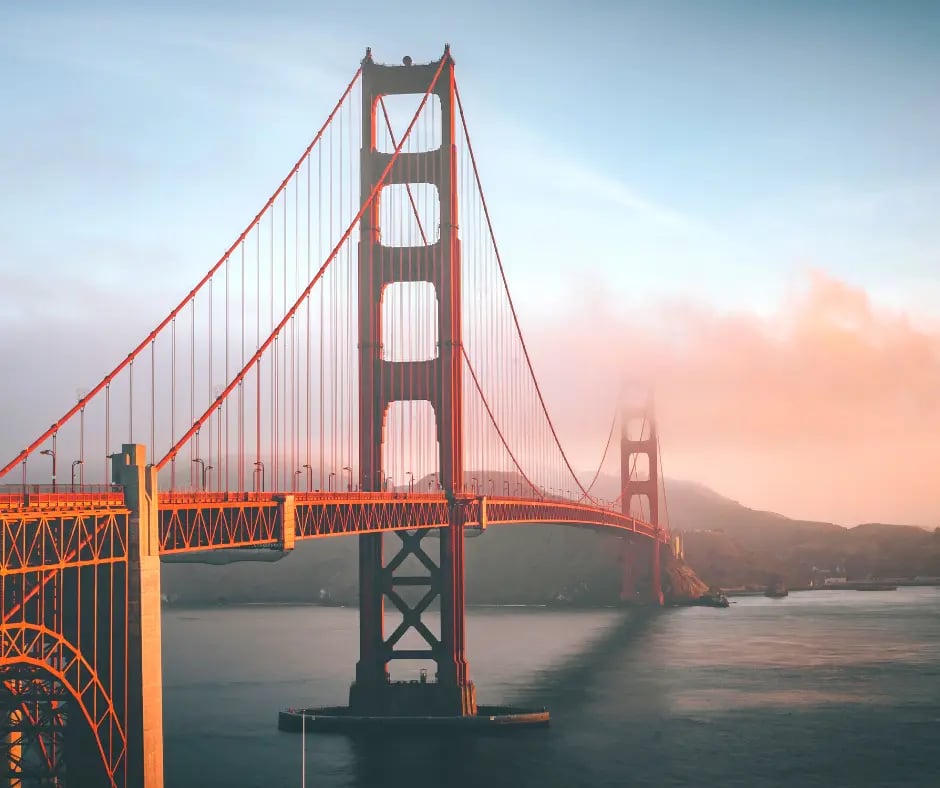
- Golden Gate Bridge: walk or cycle across from San Francisco to the Marin Headlands for the classic view.
- Mount Rainier and Olympic: glaciers, wildflower meadows and rainforest within a few hours of Seattle.
❓ Frequently asked questions
No. Remote workers usually visit on ESTA (90 days, for Visa Waiver Program countries) or a B-1/B-2 visitor visa. Neither is a work visa.
The State Department says people on visitor visas may not accept employment or work in the US, and Visa Waiver travelers fall under the same limits. There is no official rule allowing remote work for a foreign employer, so plan your stay as a visit.
San Diego and the North County coast for weather and surf, Portland for lower costs, San Francisco and Seattle for tech events and transit, Los Angeles for variety if you are happy to drive.
For a one-month stay in a furnished studio, around €2,900 to €4,300 in Portland and €4,200 to €6,300 in San Francisco, before health insurance. A room in a shared flat saves roughly €1,300 to €2,300 a month.
It depends on the plan. Genki Traveler with the region "worldwide" covers the US. With "worldwide (limited in Canada & USA)", only emergencies that start within 7 days of arrival are covered. Under the current conditions, Genki Native covers emergencies only in the US. Existing customers keep their previous conditions until their next insurance year.
September and October work almost everywhere: warm in California and still dry in the Pacific Northwest. Seattle and Portland are at their best from July to September, while Southern California is mild all year.
Traveling that area? Check out the West Coast's neighborhood.
 USA east coast for nomadsNo nomad visa, high costs and expensive healthcare, but great cities a train ride apart. How remote workers can do New York, Boston, Washington, Philadelphia and Miami in 2026.
 Mexico for nomadsThe most popular nomad destination in the Americas, and for good reason: world-class cities, Caribbean and Pacific coasts, extraordinary food, and up to 180 days visa-free. Here is where to base yourself and how it works in 2026.
 Puerto Rico for nomadsPuerto Rico is US soil in the Caribbean: no nomad visa, ESTA rules, US-level prices. Here is where nomads base themselves, what it costs, and how to work through power outages.