Belize for nomads
Updated:
 Sarah KuhlemannCommunity manager
Belize is the easy-entry corner of Central America: English is the official language, the Caribbean cayes sit right on the barrier reef, and inland the Cayo District mixes jungle, rivers and Maya sites. Most Western passports get 30 days on arrival, extendable month by month, and the whole country is small enough to fly across in under an hour.
The trade-offs are just as real. Belize costs noticeably more than Mexico or Guatemala, because most goods arrive by boat. The nomad scene is small, and there is no verified coworking space, so work happens from your rental and from cafés. This guide covers both sides.
🌱 Health insurance for Belize
Genki TravelerA travel health insurance with worldwide cover. Monthly payment plans, and easy signup in less than 1 minute.Discover Genki Traveler🎯 Belize at a glance
| 🛂 Visa | 30 days visa-free for most Western passports, extendable in 30-day steps for BZ$200 (€91) |
| ⏳ Max stay | Monthly extensions at an Immigration office. The remote-work permit allows up to 6 months |
| 💶 Monthly budget | €1,000 to €2,800, from San Ignacio to San Pedro |
| 🌤 Best time | December to May (dry season). June to November brings rain and hurricane season |
| 🏝 Top areas | San Pedro (Ambergris Caye), Caye Caulker, Placencia, San Ignacio |
| 🛜 Internet | Fiber in the main towns, 4G from Digi and SMART. Starlink only with regulator approval |
| 🛡 Safety | US Level 2, with Southside Belize City at Level 3 (12 March 2026) |
🇧🇿 Entry requirements for Belize
Visa-free entry and extensions
- British citizens can visit visa-free for 30 days, and the same 30-day rule applies to most EU, US, Canadian and Australian travelers. Check your nationality on the Immigration Department's visa list.
- Extensions: each extra 30 days costs BZ$200 (€91). You get the new stamp at the nearest office of the Immigration and Nationality Department. The extension does not allow paid or unpaid employment, or running a business, without the Director of Immigration's consent.
- One catch: Swiss citizens need a visa for any stay longer than 30 days.
- Passport validity: more than 3 months after arrival, and some airlines want 6 (UK FCDO).
- Arrival form: the authorities recommend filling in the digital immigration and customs form before you fly into Philip Goldson International Airport.
- Leaving Belize: by land, or by water to Guatemala or Mexico, the departure tax is BZ$40 (€18) or US$20, paid at the border. By air, it is usually included in the fare.
The remote-work permit: Work Where You Vacation (status checked 24 November 2026)
Belize's remote-work programme still exists. It runs as the Immigration Department's Long Stay Permit, and the Belize Tourism Board markets it as Work Where You Vacation.
- Who qualifies: citizens or permanent residents of the EU, UK, US or Canada, employed outside Belize, earning at least US$75,000 a year (about €68,200), or US$100,000 (about €91,000) when applying with dependants. You also need a notarized bank reference, a police record under six months old, and travel insurance with at least US$50,000 (€45,500) of health cover.
- How it works: up to six months in a calendar year, and the permit cannot be extended. Holders cannot take employment in Belize. You apply online with the Immigration Department, wait for approval, then pay the fee on arrival at the airport.
- The fee: the two official sources disagree. Immigration lists US$500 (€455) per adult and US$200 (€182) per child, while the Tourism Board's programme page shows BZ$500 per adult and BZ$200 per child, half that. Confirm with Immigration (visas@immigration.gov.bz) before you budget.
For most nomads, monthly extensions are the simpler route. The permit mainly makes sense if you want six months without monthly office visits and you clear the income bar.
✈️ How to get to Belize
- By air: Philip S.W. Goldson International (BZE), near Belize City, is the international gateway for most travelers. From Europe you will usually connect through a US hub.
- Domestic flights to your base: Tropic Air connects BZE with San Pedro, Caye Caulker, Placencia, Punta Gorda, Dangriga and Corozal, and Maya Island Air runs daily scheduled flights to destinations including San Pedro, Dangriga and Placencia.
- Water taxis to the cayes: San Pedro Belize Express quotes about 45 minutes from Belize City to Caye Caulker, 1.5 hours to San Pedro, and about 30 minutes between the two cayes. January 2026 tourist fares were BZ$45 to BZ$59 (€20 to €27) one way to Caye Caulker and BZ$65 to BZ$69 (€30 to €31) to San Pedro, depending on the operator.
- Overland from Mexico: cross at Chetumal into Corozal District. There is also a water taxi from Chetumal to San Pedro or Caye Caulker, about BZ$147 (€67) one way. Arriving that way, you overnight on a caye before continuing to Belize City.
- Overland from Guatemala: from Flores and Tikal, cross at Melchor de Mencos into Benque Viejo, 15 minutes from San Ignacio.
🗺 Where to base yourself
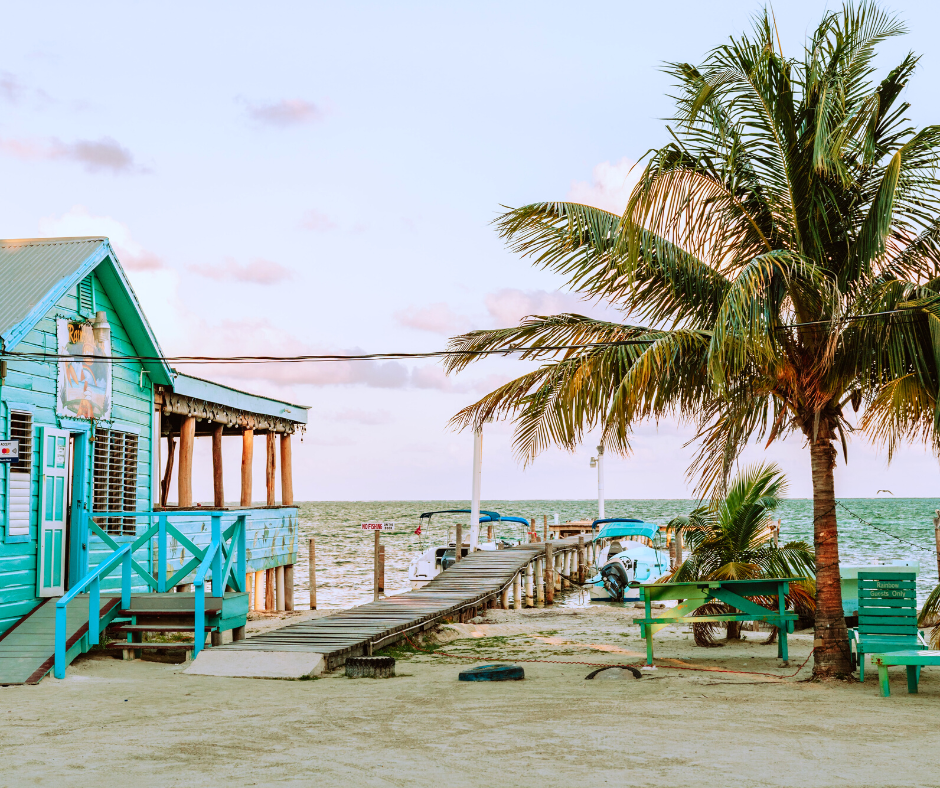
- San Pedro (Ambergris Caye) has the most infrastructure: the widest choice of furnished rentals, supermarkets, clinics, the best connectivity and the biggest expat community. It is also the most expensive base. Stay near town to get around by bike, or north of the bridge for quieter resort-style condos, where you will need a golf cart.
- Caye Caulker is the "go slow" island: sand streets, the reef a short boat ride away, and a backpacker and dive crowd. It is cheaper and more social than San Pedro, but services are thinner. Test the Wi-Fi before committing to a month.
- Placencia sits at the tip of a long, narrow peninsula in the south, with a beach-village feel, a settled expat community, and quick access to the southern cayes and Cockscomb. Placencia Village is walkable, while the resorts up the peninsula need transport.
- San Ignacio (Cayo District) is the inland, budget-friendly choice: a market town on the river, close to Xunantunich, Caracol, ATM cave and the Guatemalan border. Cooler nights, lower prices, and less touristy than the coast.
- Belize City works best as a transit point for the international airport, water taxi terminals and bus connections. Government advisories focus on its south side (see Safety).
💶 How much does it cost?
| Per month | San Pedro | Caye Caulker | Placencia | San Ignacio |
|---|---|---|---|---|
| Furnished studio or 1BR | €900–1,800 | €800–1,300 | €650–1,650 | €600–1,300 |
| Food | €400–600 | €350–500 | €350–500 | €300–450 |
| Transport | €50–250 (bike or golf cart) | €20–50 (bike) | €30–150 | €40–150 |
| Utilities | €50–150 | €40–120 | €40–120 | €40–100 |
| Realistic total | €1,400–2,800 | €1,200–2,000 | €1,050–2,400 | €1,000–2,000 |
Rents are based on furnished monthly listings in November 2026: resort condos north of the bridge on Ambergris Caye start around US$2,000 for a one-bedroom, while monthly apartments a mile south of San Pedro start at US$1,000. Caye Caulker cabanas run about US$1,100 to US$1,300, Placencia ranges from a US$686 budget cabana to about US$1,800, and San Ignacio from about US$950 to US$1,450. Conversions use €1 = US$1.099 = BZ$2.198 (ECB reference rate, 20 November 2026), and the Belize dollar is pegged at BZ$2 to US$1.
Short stays sit at the top of each range, especially in high season (December to April) and near the beach. Electricity is often billed on top of rent, and air conditioning adds up quickly. The food, transport and utility lines are estimates. For comparison, the region's value bases such as Oaxaca and Cuenca run well below these figures:
 Latin America made easyWhere to start in Latin America as a remote worker: 11 bases compared on real monthly costs, the visa that works in each, internet, seasons, and two sample routes for your first three months.
🧑🏻💻 Where to work from
Belize has no coworking space that could be verified on its own website in November 2026. Remote work here means three things:
- Your rental: ask for a recent speed test and whether the price includes fiber internet.
- Cafés: fine for focused hours, less reliable for calls.
- A backup: a local SIM with a data bundle for when the Wi-Fi drops.
If you need a desk and a community every day, Belize works better as a 2 to 4 week stop than as a long base.
👥 Finding community
The nomad scene is small and mostly mixed in with the expat and dive communities. San Pedro has the largest English-speaking expat community, Caye Caulker draws a younger, transient crowd built around diving and the island's bars, and Placencia has a settled expat scene. Noma Collective has run month-long remote-work editions in Placencia, most recently listed for January 2026, so check its site for 2027 dates.
The fastest way in is through dive shops, yoga classes and group tours, plus regional events if your route takes you through Mexico or Guatemala.
🛜 Internet and SIM cards
Belize has two mobile networks: Digi, run by Belize Telemedia (BTL), and SMART, run by Speednet. Prepaid Digi SIMs are sold at BTL's Digi Stores and authorized agents nationwide. BTL has proposed buying Speednet, and the deal is still under legal and regulatory review, so plans may change over the next couple of years.
Starlink is not generally available. In January 2025 the Public Utilities Commission refused Starlink a licence to sell service nationally. Terminals are only allowed in limited circumstances, and new users are assessed case by case, so do not plan your setup around bringing a dish. Ask your host about backup power too, especially on the cayes and during storm season.
The simplest way to stay connected is a global eSIM from Pangia: one plan that covers Belize and whatever country comes after it, set up before you land. For a month or longer, add a local prepaid SIM for a Belizean number and cheaper data.
🌤 When to go where
| Region | 🌞 Best time | 🌧 Avoid | Why |
|---|---|---|---|
| Cayes (San Pedro, Caye Caulker) | Dec–May | Sep–Oct | Dry season, calmer seas and the best reef visibility. Peak hurricane risk in early autumn |
| Placencia and the south | Dec–May | Sep–Oct | Same rhythm as the cayes, and the south gets more rain |
| San Ignacio and Cayo | Feb–May | Jun–Nov | Dry trails and easier cave and ruin trips. Heavy rain makes jungle roads harder |
According to Belize's National Meteorological Service, most of the year's rain falls from June to November, and the Atlantic hurricane season officially runs from 1 June to 30 November. December to April is high season, with the highest rents.
🚌 Getting around
- Water taxis link Belize City, Caye Caulker and San Pedro several times a day (see How to get to Belize).
- On the cayes, you get around by bicycle, on foot or by golf cart. Golf carts are the norm north of San Pedro.
- Domestic flights with Tropic Air and Maya Island Air are the fastest way between the coast, the cayes and the south.
- Buses connect the towns, but Canada's travel advice recommends avoiding them, citing poor maintenance and missing safety equipment. Shuttles or flights are the more comfortable alternatives.
- Car rental works well inland, especially for Cayo. A UK photocard licence is valid for up to 3 months, and the US advisory discourages driving between cities after dark.
🚧 Safety
- US advice: the US advisory, issued 12 March 2026, rates Belize Level 2 (exercise increased caution) because of crime, and Southside Belize City Level 3 (reconsider travel). That area runs south of Haulover Creek, much of its violent crime is gang-related, and most crimes go unsolved. Sexual harassment and assault of people traveling alone or in small groups have been reported.
- UK advice: on 1 November 2026, Belize declared a 30-day state of emergency in parts of Belize City and the Belize and Cayo Districts, after a rise in gang-related violence (UK FCDO). The areas include the Southside and Westside of Belize City and two Cayo villages along the George Price Highway. Expect more police and checkpoints there, and carry ID. The cayes, Placencia and San Ignacio town are not on the list.
- Canada's advice: exercise a high degree of caution nationwide, and avoid non-essential travel to Southside Belize City.
- Adventure activities: the UK notes injuries and deaths from adventure activities, including snorkeling and diving. Book licensed operators.
🏥 Healthcare
Care in Belize is limited and costly. The US State Department says private care is expensive and often needs upfront payment, and it advises evacuation cover. The main private hospitals and the public referral hospital are in Belize City, the cayes and smaller towns have clinics, and serious cases are often flown to Mexico or the US. For divers, Belize's only hyperbaric chamber is in San Pedro on Ambergris Caye.
The CDC advises that tap water is not drinkable, so stick to bottled or filtered water, which is widely available. Dengue is present, so use repellent, especially at dusk and in the wet season.
🎖 Must see
- Great Blue Hole: the giant marine sinkhole on Lighthouse Reef. A full-day boat trip from San Pedro or Caye Caulker for divers and snorkelers, or a scenic flight with Tropic Air.
- Hol Chan Marine Reserve: reef, seagrass and Shark Ray Alley at the south end of Ambergris Caye, an easy half day from San Pedro.
- Caracol: the largest Maya site in Belize, deep in the Chiquibul forest south of San Ignacio.
- Xunantunich: a hilltop Maya site near the Guatemalan border, reached by a hand-cranked river ferry.
- ATM cave (Actun Tunichil Muknal): a wet cave with Maya ceremonial remains. Per NICH, every visitor needs a certified ATM guide, with at most six people per guide, and you must be able to swim. Cameras are not allowed.
- Cockscomb Basin Wildlife Sanctuary: jaguar reserve with rainforest trails and waterfalls. The entrance road starts at Maya Centre on the Southern Highway.
❓ Frequently asked questions
Sort of. The Work Where You Vacation programme is a six-month Long Stay Permit for citizens or residents of the EU, UK, US or Canada. It needs US$75,000 a year in income from outside Belize, and it cannot be extended. Most nomads simply extend the 30-day visitor stamp month by month instead.
30 days on arrival for most Western passports, then 30-day extensions at an Immigration office for BZ$200 (€91) each. The Long Stay Permit covers up to six months in a calendar year.
Yes, compared with its neighbors. A realistic short-stay month runs from about €1,000 in San Ignacio to €2,800 in San Pedro, because rents on the cayes and imported food push costs up.
San Pedro for infrastructure, Caye Caulker for a slower, cheaper island, Placencia for a quiet beach village, and San Ignacio for jungle, ruins and the lowest costs.
In the main towns, usually yes, with fiber in many rentals and 4G as backup. Check speeds before booking. There are no verified coworking spaces, and Starlink is not generally available.
The US rates Belize Level 2 (increased caution), with Southside Belize City at Level 3. The usual bases are outside the areas the advisories focus on. Avoid driving between towns after dark, and check the current UK, US or Canadian advice before you travel.
Traveling that area? Check out Belize's neighborhood.
 Mexico for nomadsThe most popular nomad destination in the Americas, and for good reason: world-class cities, Caribbean and Pacific coasts, extraordinary food, and up to 180 days visa-free. Here is where to base yourself and how it works in 2026.
 Guatemala for nomadsGuatemala has no visa called a digital nomad visa, but 90 visa-free days and a new remote-worker residence make long stays possible. Bases, real costs and the advisory, explained.
 Honduras for nomadsWorld-class diving, a Caribbean island with an English-speaking expat community, and some of the cheapest reef access on earth. Honduras works for nomads if you understand one thing: base yourself on the Bay Islands. Here is the honest 2026 guide.Latin America made easyWhere to start in Latin America as a remote worker: 11 bases compared on real monthly costs, the visa that works in each, internet, seasons, and two sample routes for your first three months.